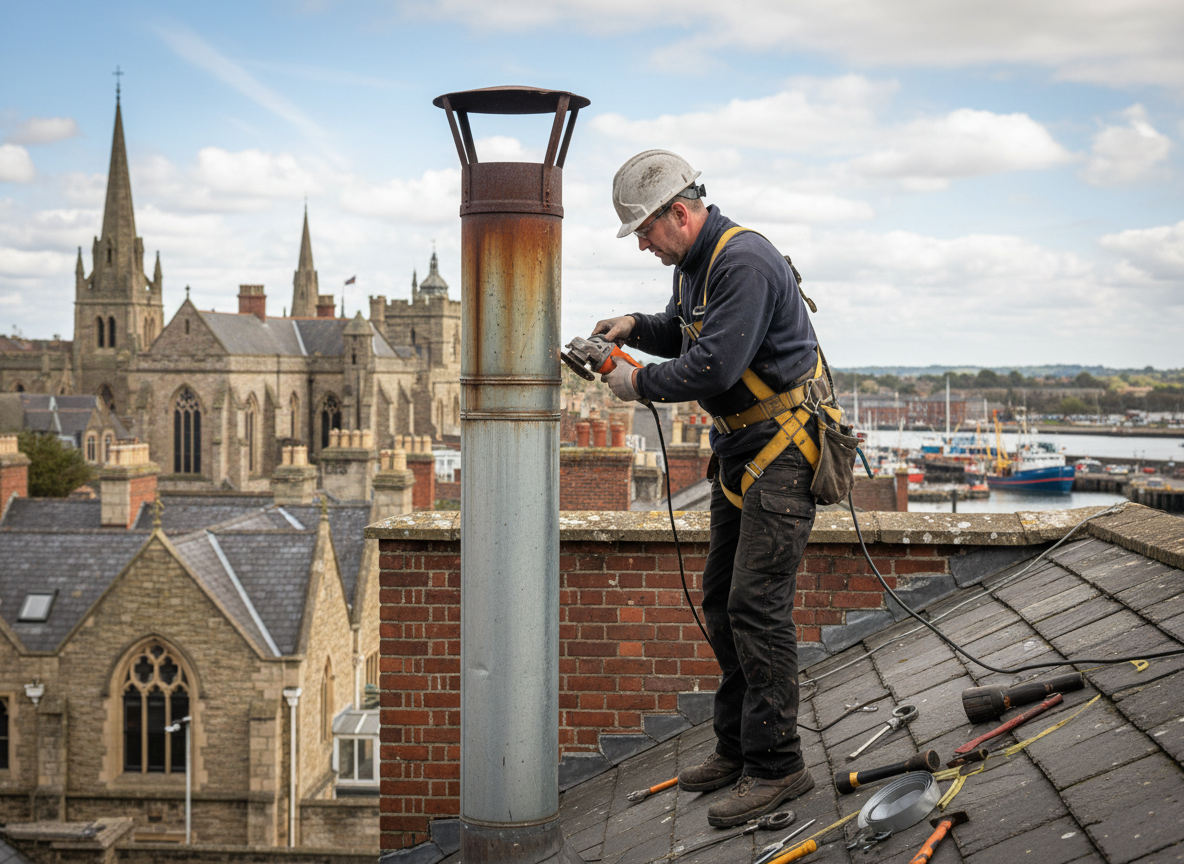
Metal chimneys in Gloucester City homes often show seam separation and rust along the exterior where winter freeze-thaw cycles and Delaware River humidity accelerate corrosion. Older stock along Cumberland Street and surrounding blocks commonly uses thin-gauge liners that pit faster once the protective coating breaks down. Technicians at 523 Cumberland St check for hidden creosote pockets behind the metal that can hide active leaks into the attic space.
Repair work here requires matching the original gauge and alloy to avoid future galvanic reaction when new sections join older pipe. Flashing integration at the roofline must account for the steep pitches found on many Gloucester row homes, where improper overlap lets wind-driven rain run behind the metal. Edge cases include chimneys serving oil furnaces that produce more acidic condensate, which eats through standard stainless faster than gas appliances.
Homeowners sometimes attempt to patch with roofing tar, but that traps moisture and speeds delamination of the metal. Proper repair starts with a camera inspection to map every compromised joint before any cutting or welding begins. Replacement sections are sealed with high-temperature silicone rated for the flue temperatures typical in this region rather than generic caulk that fails within a season.
Access on narrow Gloucester lots often limits staging, so crews work from ladders and roof brackets rather than full scaffolding. This changes the sequence when the damage runs the full height of a two-story chimney. Final testing includes a smoke draw check to confirm the repair has not altered draft before the job is closed out.
Technician insight
In Gloucester the thing that catches most people out with metal chimney repair is how fast the Delaware River humidity plus winter road salt in the air pits the exterior seams on chimneys that vent oil or older gas appliances. Homeowners on blocks like Cumberland Street often think a visible rust spot is the whole problem when the real failure is hidden behind the liner where creosote has trapped moisture for years.
Seam Failure on Two-Story Metal Chimney
A Gloucester City homeowner noticed water stains in the upstairs ceiling after heavy rain. Camera inspection revealed rusted seams on the metal liner two floors up where the chimney passed through the attic. Crews replaced the upper two sections, re-locked the joints and reset the flashing. The attic stayed dry through the next several storms.
How it works
- 1
Initial Camera Inspection
Technician scopes the full length of the metal chimney from the appliance to the cap to locate rust, gaps and creosote buildup.
- 2
Damage Assessment
Findings are reviewed with the homeowner on site, noting which sections can be patched versus fully replaced based on remaining metal thickness.
- 3
Targeted Repair or Section Replacement
New metal is cut and fitted on site, seams are welded or mechanically locked, and high-temperature sealant is applied at all joints.
- 4
Flashing and Weatherproofing
Roof flashing is reset or renewed to direct water away from the chimney exterior, then a final smoke test confirms proper draft.
Pricing
Upfront quotes issued after the camera inspection; final price depends on height, number of compromised sections and roof access.